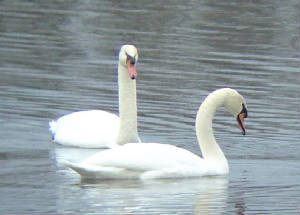
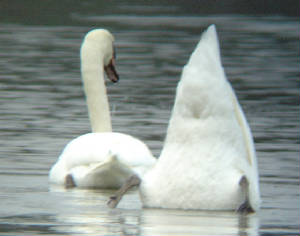
Just a quick type about the swans:
Michael and I found and have tracked these Mute Swans at Lake Horton because we feel these are actually wild Mute Swans.
We have found Mute Swans in the past in Georgia on public waters, but these are different.
I do not have time to go into too many details. I will provide more info when I have time to review my notes and
consult with Michael.
Exotics can show up anywhere. I hope the term "exotic" is not misinterpreted by others. Since we are birdwatchers,
I would think the word "exotic" should be viewed in a birding context. The National Audubon Society's "The Sibley
Guide to Birds" 2000 edition written and illustrated by David Allen Sibley states on page 89, "Exotic Waterfowl:
Exotic species frequently escape from zoos and private collections;" and he lists some species: Mandarin Duck, Egyptian Goose,
Ruddy Shelduck, and Black Swan." However, he lists Mute Swan on page 72 (with Trumpeter Swan). He also shows the
range coming downward close to Georgia. Mute Swan is on the State List for Tennessee and North Carolina and the Provisional
list of South Carolina, as far as I remember. It is not on the official or provisional list for Georgia. I will
submit details to the Record's Committee for these birds.
Going from memory, FIVE immature Mute Swans first appeared in the late summer of 2002 at Lake Horton.
The birds formed two pairs and the fifth was pushed aside. Then they left in the Spring of 2003. Then four returned
in the late summer/early fall of 2003. They continued until the spring and left again. The four returned in the
late summer/early fall of 2004.
Michael and I have reported the birds and taken photos of them.
We've seen the birds flying many times. I've found them at J.W. Smith Reservoir and noted that they had left Lake
Horton to go there and then return. So, the birds travel around the area. Though Lake Horton is there
regular hangout. We've seen people try to give the birds bread, but so far the Mute Swans have shown no interest in
bread. Mute Swans as a species are approachable in the wild, and these at Lake Horton are somewhat approachable.
The first couple years though they were skiddish of people. The birds do not have bands on their legs. I have
not heard from any private collectors about any missing birds.
The population of Mute Swans from New York to Virginia has increased alarmingly in the last twenty years. The Atlantic
Flyway Council wants to take steps to reduce the wild Mute Swan population from expanding into the Atlantic
states including Georgia. This is a complex issue, and I don't have time to get into it.
The new $10 entry fee into Lake Horton has made it difficult to monitor the lake or swans.
Eric Beohm