Georgia Birding and Nature

Mottled Duck (Inland)

Home
Birding Year 2007
Birding Year 2006
Birding Year 2005
Birding Year 2004
Scott's Oriole
Yellow-billed Loon
Red-throated Loons @ West Point
Red-throated Loons (Inland)
Pacific Loon
Western Grebe
Eared Grebes
Eared Grebes
Horned Grebe (summer)
Red-necked Grebe
Swainson's Hawk
Pomarine Jaeger (Inland)
Long-tailed Jaeger (Inland)
Mottled Duck (Inland)
Arctic Tern (Inland)
Bell's Vireo
Bell's Vireo more photos
Warbling Vireo
Thayer's Gull
Thayer's Gull - more photos
Franklin's Gulls
California Gull, Glaucous Gull, Iceland Gull, Thayer's Gull
Lesser Black-backed Gull (Inland)
Lesser BB Gull (WP Lake)
Magnificent Frigatebirds (Inland)
More Frigate Photos
Sooty Terns, Royal Tern, & others (Inland)
Rare Ducks
Gadwall (summer)
Cave Swallow (Inland)
Long-billed Curlews
Black-billed Cuckoo
Black-billed Cuckoo
Clay-colored Sparrows
Lark Sparrow
Lincoln's Sparrow
Wilson's Warbler
Wilson's Warblers
Audubon's Warbler
Least Flycatcher
Scissor-tailed Flycatcher
More Scissor-tailed
Western Kingbird
Western Kingbird
Snow Goose
Snow Goose
Snow Goose
Greater White-fronted Geese
Greater White-fronted Geese and Snow Geese
Greater White-fronted Geese
Brant
Ross's Goose in Henry County
Ross's Goose in Upson County
Ross's Geese in Fayette County
Ross's Goose in Stewart County
Ross's Geese Elsewhere
Mute Swans (appearing wild)
Black Swans (exotic)
Rare Shorebirds
Willets Inland
Baird's Sandpiper
Buff-B & Upland Sandpipers
American Golden Plover
Night-Herons in Piedmont
Wood Storks in Piedmont
Herons & Ibises
White Ibis (Piedmont in Winter)
Common Ground-dove in Piedmont
76 White Pelicans (Inland)
American White Pelicans
Brown Pelican Inland
Swallow-tailed Kites in Piedmont
Golden Eagle
Western Red-tailed Hawk
Brewer's Blackbirds
Brewer's Blackbird
Anhinga in Conyers
Anhingas in Piedmont
Anhingas Nesting in Piedmont
Pelagic Birds
More Katrina Birds
Lake Seminole Birds
Sapelo Island
West Point Lake
Nesting Birds
Cedar Waxwings Nesting in Southern Piedmont
Photos from Lake WFG
Recent Photos
Recent Photos
Recent photos
Recent Sightings
Recent Sightings
Recent Sightings
Recent Sightings
Recent Sightings
Recent Sightings
Yard List
Bird Houses

I found this Mottled Duck at E. L. Huie LAF in Clayton County (piedmont region of GA, Atlanta area) on Aug 30, 2006.  Need I say, "Wow!"? 
 
Probably the rarest bird I've seen at E. L. Huie which says a lot.  The Annotated Checklist of GA Birds (2003) lists no inland records for GA for this species. 
 
Eric Beohm

mottledbestbigdsc05553.jpg

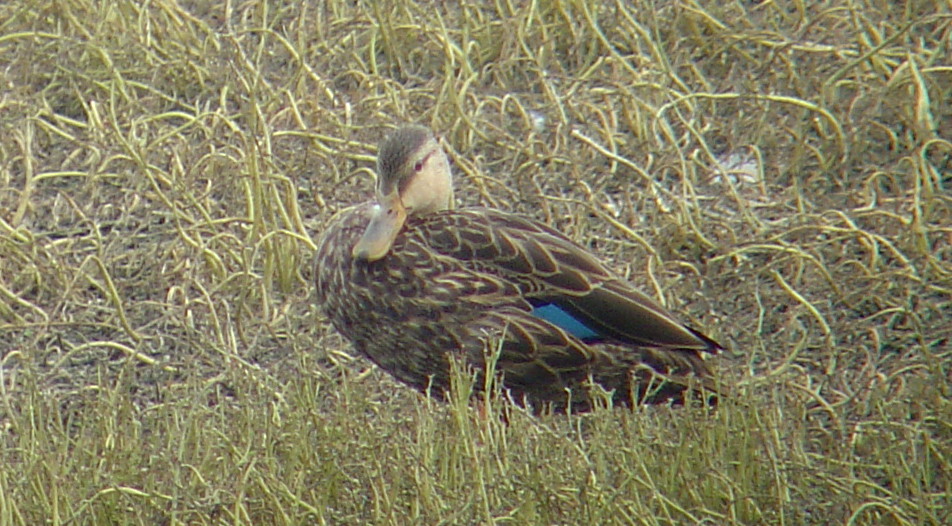
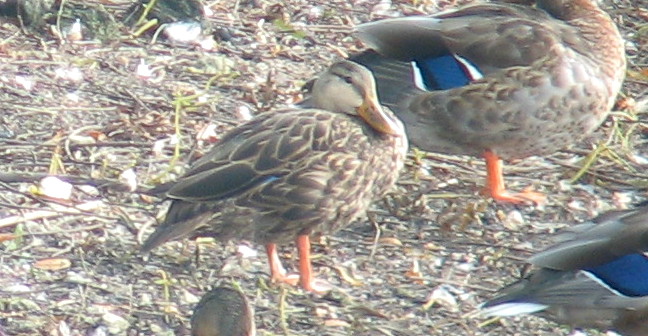
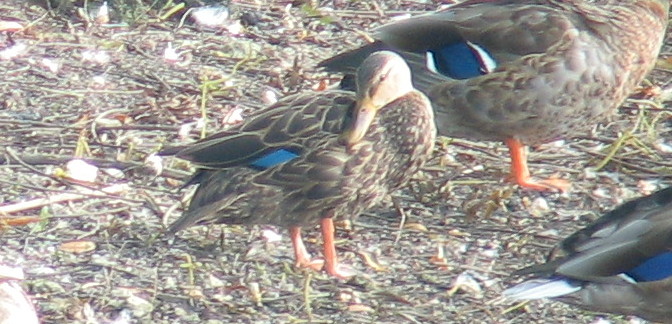
The bill of this bird is typical for a female.  Usually photos are of adult males with yellow bills.  The bill for Mottled Ducks ranges from yellow to orange; many times orange with dark on top. 
 
The pale crown is evident in this photo.  It was paler than most if not all of the Mallards around it, and much paler than on American Black Ducks that I've seen.
 
You can see the buffy chevrons on the body plumage.  The contrast of the chevrons vary on Mottled Ducks with some that I've noted being quite faint, but these are quite noticeable.  You can even see streaks on the back which vary with Mottled Ducks, though I doubt this is a significant fieldmark. 
Update:  I re-examined the bird's back through my spotting scope and did note that the back feathers have lines running down them about halfway.  So, this fieldmark checks out fine.  I added some photos showing this.

mottled2bigdsc05535.jpg

All emails I've gotten have agreed that this is a Mottled Duck.  Others who do not have experience with the species asked me what do I look for.  Let's go over the fieldmarks.
 
This bird is almost a carbon copy of many Mottles on the internet.  It is identical to ones I've seen before.  It fits the Sibley Book to a tee.
 
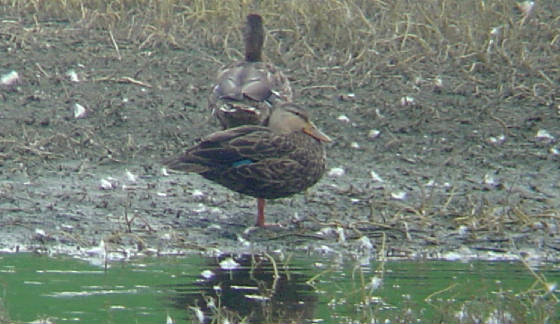
Size is about one inch smaller than the Mallards.  The slightly smaller size is noticeable.  I compared it with a number of Mallards.   In contrast, Black Ducks are the same size.  A Black Duck hybrid would tend to be the same size.  I've seen many Black Duck hybrids.  I think I have reported more than any other birder in GA.  This is not like any hybrid I've ever seen.
 
The neck is noticeably thinner than the Mallards.  Black Ducks do not have thinner necks, nor would I think a hybrid.
 
The crown is paler than a Black Duck, and consistent with Mottled.  The supercilium is most consistent with Mottled in my opinion.
 
Very noticeable while veiwing the live bird and not so much from the photos is the buffy, unmarked throat area, which again is not a fieldmark of Black Duck, Mallard, or hybrid.
 
The bill is consistent with field guides, photos, and my experience for Mottled.  The black spot on the gape is there, though not extensive like in some breeding adults, but consistent with Mottled and not as much as with Mallard or Black Duck.
 
The back feathers are consistent with Sibley Guilde, my experience with this speices, and most photos on the internet of birds known to be Mottles.  The back seems more consistent with the juvenile Mottled in Sibley.  It is not consistent with hybrids that I have seen.
 
When I viewed the outstretched wing, it was identical to the specimen wings and to the reference guides.  The speculum is more consistent with Mottled than Black Duck and doesn't support hybrid.  The speculum is more a bluish purple than a purple color of Black Duck.  The bird had a very faint white trailing edge to the speculum.  This is hard to see, though I captured it in some photos.  A couple times I saw just the faintest white leading edge of the speculum.  This is supportive of Mottled only. 
 
Buffy Chevrons can be seen on the body feathers supporting Mottled.  Sibley describes it as a warm brown color which can be seen in the photos.  The bottom photo shows this more because I used a better camera for that shot.
 
The tail was all dark.  I think one photo gives the illusion of a white edge on the tail, but that was something white in the background.  The dark tail would not fit a hybrid.  Also, there was no curl to the tail which hybrids sometimes have.
 
Also, last but not least, the overall jizz was that of a Mottled.
 
So, what is it doing here?  Well, Mottles have been recorded inland in other states including Tennessee.  I was looking at a photo of one seen up there, and it is similar to this one.  So yes, birds can travel far...after all, they do have wings!
 
Eric Beohm


mot3dsc05524.jpg

Note the slender neck.  This seems to be a great fieldmark for this species.  I've noted it many times on birds on the coast.
 
Also, the buffy throat which is very evident on this bird appears to be another great fieldmark from what I've seen in the past and from photos.  These photos do not capture it as well as when I viewed the bird up close.
 
 
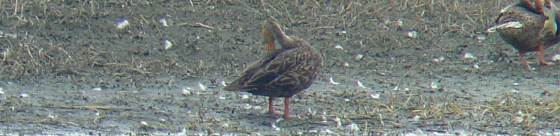
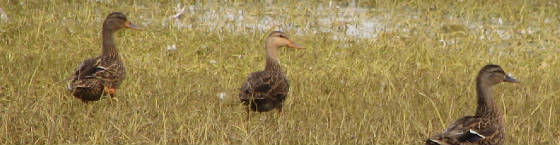
Note the photos below showing the back feathers with buffy streaks characteristic of Mottled Duck.

mottledimg_3965.jpg

mottledimg_3964.jpg

mottledimg_3944.jpg

mottledduckimg_3807.jpg

This is a neat photo.  I took it with a different digital camera.  The color fidelty is better, and you can see the warm tones of a "classic" Mottled Duck.  Note that the size of the bird is slightly smaller than the Mallards beside it which you would expect from a Mottled.  Again, much of the same critical fieldmarks are reiterated like the buffy throat, thin neck, bill color, overall plumage.  Really neat!